
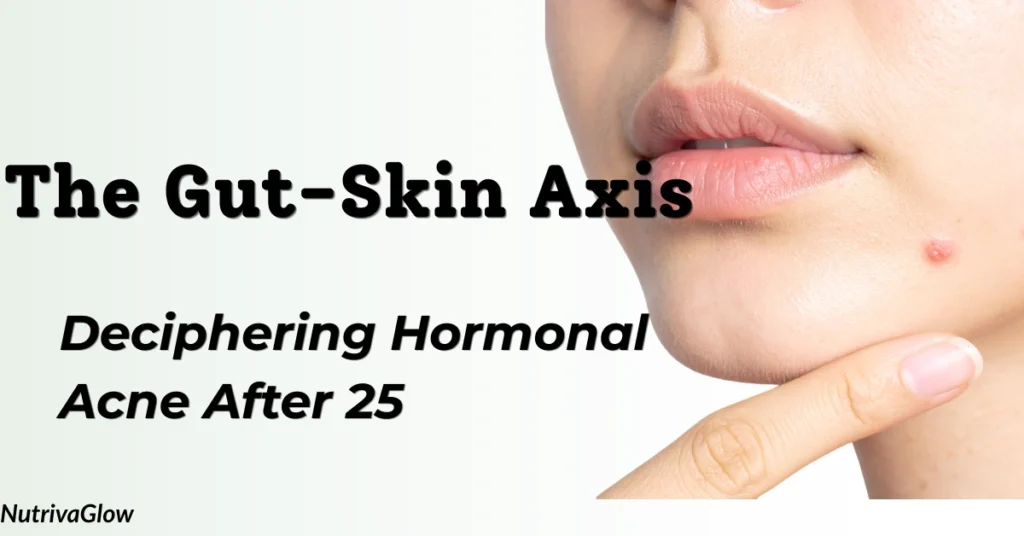
You are not failing at skincare. Your skincare is failing to reach the conversation your body is actually having.
By the NutrivaGlow Editorial Team·April 2026·14 min read
There is a particular kind of frustration that belongs to women over 25 who still break out.
It arrives in the mirror on an otherwise ordinary Tuesday morning. You have done everything you were told. The gentle cleanser. The retinol. The zinc spot treatment. You changed your pillowcase. You cut dairy. You drank the water. And yet — there it is again. Deep, tender, unmistakable. The same cyst, in the same place, on the same jawline. As if your skin did not receive the memo.
You are not failing at skincare. Your skincare is failing to reach the conversation.
Because hormonal acne in adult women is not a surface problem. It is a biological signaling issue — and the signal originates far below the skin.
This Is Not the Acne You Had at 16
Why adult breakouts follow different biological rules
Teenage acne is largely driven by the first surge of androgens during puberty — a temporary hormonal flood that, for many, eventually stabilizes. It is noisy, widespread, and often resolves on its own.
Adult hormonal acne operates through a quieter, more persistent mechanism. It is slower. More cyclical. Deeply entangled with your stress response, your metabolic function, and — this is the part most dermatologists underemphasize — the health of your gut microbiome.
The pattern is rarely random. Deep, cystic lesions concentrated along the jawline, chin, and neck. Flares timed to specific phases of your menstrual cycle or stretches of sustained stress. A 2025 systematic review examining the etiology of adult female acne confirmed that androgens, insulin-like growth factor 1 (IGF-1), and dietary glycemic load are among the most consistently implicated factors — operating through mechanisms that are fundamentally different from the acne of adolescence (Telkkälä et al., 2025, Health Sci Rep).
This is your skin translating an internal hormonal imbalance into visible inflammation.
“Your skin is not misbehaving. It is reporting.”
The Androgen–Sebum Conversation
The biological core of hormonal acne
At the biological core of hormonal acne is the relationship between androgens — including testosterone and its more potent derivative, dihydrotestosterone (DHT) — and your sebaceous glands. When androgen levels rise, or when the skin’s sensitivity to normal androgen levels increases, the glands respond with excess sebum. This oil, mingling with dead skin cells and inflammatory signals, creates the environment in which Cutibacterium acnes bacteria proliferate and cysts form.
Research has established that androgens play a particularly important role in adult acne because they stimulate growth of the sebaceous glands and increase sebum secretion, promoting the formation of acne lesions. Critically, most adult women with hormonal acne have normal circulating androgen levels — suggesting that the issue lies in heightened receptor sensitivity at the pilosebaceous unit rather than in overt hormonal excess (Al-Hilo et al., 2024, J Dermatolog Treat).
What elevates androgen activity in adult women? Chronic stress. Insulin resistance. Poor sleep. And — less discussed, but equally critical — impaired estrogen metabolism in the gut.
🔬
What the Research Shows
Serum IGF-1 levels have been found to be significantly elevated in women with post-adolescent acne compared with age-matched controls. IGF-1 stimulates 5-alpha reductase activity, promotes androgen synthesis, and increases sebocyte proliferation and lipogenesis — establishing a direct hormonal bridge between diet, metabolism, and breakouts (Aizawa & Niimura, 1995, J Dermatol; Melnik & Schmitz, 2009, Exp Dermatol).
The Estrobolome: Where Your Gut Rewrites Your Hormonal Script
The mechanism most conventional acne approaches miss entirely
This is where the conversation shifts from dermatology to microbiology — and where most conventional acne approaches miss the mark.
Within your gut microbiome lives a specialized collection of bacteria collectively known as the estrobolome. These bacteria produce an enzyme called beta-glucuronidase, which plays a decisive role in regulating how estrogen is metabolized: whether it is properly eliminated or quietly recirculated back into your bloodstream.
When the microbiome is diverse and balanced, this system runs efficiently. Used estrogen is conjugated in the liver, sent to the gut via bile, and excreted. When the microbiome is disrupted — through antibiotic exposure, chronic stress, a low-fiber diet, or years of ultra-processed eating — beta-glucuronidase activity becomes dysregulated. Conjugated estrogen gets cleaved back into its active form and reabsorbed into circulation (Ervin et al., 2019, J Biol Chem).
The result: estrogen dominance. An excess of circulating estrogen relative to progesterone. This imbalance does not merely affect mood and cycle regularity. It directly influences androgen activity, sebum production, and the skin’s inflammatory threshold.
A 2023 review in Gut Microbes confirmed that gut microbial beta-glucuronidase is a key functional mediator of estrogen metabolism, and that its dysregulation has been implicated in a range of estrogen-driven conditions — providing mechanistic support for the link between microbiome disruption and hormonal skin issues (Qi et al., 2023, Gut Microbes).
Your gut is not just digesting food. It is editing your hormonal script. And your skin is performing whatever version it receives.
The Cortisol Amplifier
How chronic stress biochemically rewires your hormonal environment
Layered on top of the estrobolome is cortisol — the body’s primary stress hormone.
Chronically elevated cortisol stimulates the adrenal glands to produce more androgens (particularly DHEA-S), feeding the sebum overproduction cycle directly. Cortisol also increases intestinal permeability — the phenomenon sometimes called “leaky gut” — which triggers systemic, low-grade inflammation that surfaces visibly on the skin.
Stress does not simply make you feel worse. Through this cascade, it biochemically rewires your hormonal environment — making breakouts more frequent, more severe, and slower to heal. The HPA (hypothalamic–pituitary–adrenal) axis, once chronically activated, impairs skin barrier repair, accelerates collagen degradation, and heightens the skin’s inflammatory sensitivity to triggers that a balanced system would absorb without visible consequence.
💡
The Stress–Skin Feedback Loop
This is not a one-directional pathway. Visible skin distress can itself become a source of psychological stress, which further elevates cortisol, which further impairs gut integrity and hormonal balance. Understanding this loop is essential — because it means effective treatment must address the emotional dimension alongside the biological one.
Why This Happens After 25
The accumulation effect your body has been recording
Gut dysbiosis rarely develops overnight. It accumulates. Repeated antibiotic courses. A diet low in diverse fibers and fermented foods. Chronic psychological stress. Disrupted sleep architecture. The long-term use of hormonal contraceptives, which are known to alter microbiome composition.
By the mid-to-late twenties, many women are experiencing the compounded effect of years of these inputs — even if their diet and lifestyle have improved significantly in recent years. The estrobolome–estrogen relationship is a reflection of cumulative microbial history, not just current dietary choices.
After 25, the body also undergoes subtle metabolic shifts. Insulin sensitivity can begin to decline, particularly in the context of chronic stress and poor sleep. Elevated insulin stimulates the ovaries to produce more androgens and promotes IGF-1 activity — both of which accelerate sebum production in ways that favor clogged pores. Research has confirmed that insulin resistance is significantly more prevalent in acne patients than in healthy controls, and that insulin, androgens, and IGF-1 share overlapping signaling pathways in acne pathogenesis (Gruszczyńska et al., 2023, Biomedicines).
This is why women who “never had acne” begin breaking out after 25. It is not a regression. It is the delayed manifestation of accumulated internal imbalances finally reaching a visible threshold.
Supporting Hormonal Balance: The Inside-Out Approach
Evidence-informed foundations — not shortcuts
Nutritional Foundations
Fiber is non-negotiable. A high-fiber diet supports healthy estrogen elimination by feeding the beneficial bacteria of the estrobolome and promoting regular bowel transit — ensuring that excess estrogen leaves the body rather than being recirculated. The estrobolome’s functional capacity is directly shaped by dietary substrate: without adequate fiber, beta-glucuronidase regulation falters (Baker et al., 2017, Maturitas).
Cruciferous vegetables — broccoli, Brussels sprouts, cauliflower, kale — contain DIM (diindolylmethane) and sulforaphane, compounds that support healthy estrogen metabolism in the liver and promote the clearance of excess androgens.
Ground flaxseed provides both soluble fiber and lignans, which support balanced estrogen signaling. Colorful, polyphenol-rich foods — berries, pomegranate, green tea — support microbiome diversity and quiet the systemic inflammatory signals that aggravate the skin.
Reducing refined sugar and high-glycemic foods is foundational. A low-glycemic dietary pattern has been shown to reduce IGF-1 levels in acne patients, directly dampening the insulin–androgen cascade that drives sebum overproduction and follicular keratinization.
Circadian Alignment and Sleep
The body performs the majority of its hormonal regulation, cortisol clearance, and cellular repair during sleep — particularly during the deep and REM stages between 10 PM and 2 AM. Chronically late schedules or fragmented sleep directly impair this process, keeping cortisol elevated and compromising the skin’s overnight regeneration.
Consistent sleep timing — same wake and sleep times, even on weekends — stabilizes the cortisol awakening response. Reducing screen exposure 90 minutes before bed supports melatonin production, which has demonstrated antioxidant effects on the skin. Magnesium glycinate (300–400 mg before bed) is widely used to support sleep depth and healthy cortisol clearance overnight.
Stress Regulation
Because the HPA axis directly modulates both gut permeability and androgen production, any effective inside-out protocol must include meaningful stress management — not as a luxury, but as a physiological necessity. The specific modality matters less than the consistency: breathwork, meditation, regular moderate exercise, and time in nature have all demonstrated measurable effects on cortisol regulation.
“The question is not whether stress affects your skin. The question is whether you are addressing it at the level of the system, or only at the level of the symptom.”
Curated Supplement Support
Precision instruments — not shortcuts. Diet, sleep, and stress regulation come first.
Evidence-Referenced
Zinc Bisglycinate
One of the most studied minerals in the context of hormonal skin health. Zinc supports healthy testosterone metabolism, helps regulate sebaceous gland activity, and contributes to the skin’s natural inflammatory balance.
Form matters: Bisglycinate or picolinate for superior absorption. Generic zinc oxide is poorly bioavailable.
NutrivaGlow note: Choose pharmaceutical-grade, third-party tested. Quality varies dramatically across brands.
Evidence-Referenced
Omega-3 Fatty Acids (EPA/DHA)
EPA in particular has been studied for its role in modulating the inflammatory pathways that contribute to acne severity. Omega-3s also support cell membrane integrity and help counterbalance the pro-inflammatory omega-6 excess common in modern diets.
Priority: EPA content matters more than total fish oil volume. Look for concentrated formulations.
NutrivaGlow note: If you do not consume fatty fish regularly, supplementation becomes especially relevant.
Evidence-Referenced
Magnesium Glycinate
Beyond sleep support, magnesium participates in over 300 enzymatic reactions — including those governing cortisol regulation and blood sugar metabolism. Most modern diets are magnesium-insufficient.
Timing: 300–400 mg, 60–90 minutes before bed.
NutrivaGlow note: The glycinate form is preferred for its calming properties and minimal digestive disruption.
From Understanding to Action
The Gut–Skin Glow Protocol
The Protocol addresses the estrobolome, the cortisol cascade, and the insulin–androgen pathways discussed in this article — structured as a 30-day implementation system so the science becomes a daily practice, not a theoretical framework.Explore the Protocol
Your Glow Is Not Gone. It Is Waiting.
Hormonal acne after 25 is not a life sentence. It is not a referendum on how well you take care of yourself.
It is biological feedback. Your body’s way of communicating that an internal system needs attention — that the estrobolome needs rebuilding, that cortisol needs regulation, that the insulin–androgen cascade needs quieting.
When you address the gut, support healthy estrogen metabolism, regulate the cortisol cascade, and give your body the nutritional inputs it needs to metabolize hormones efficiently — the skin responds. Not overnight. But consistently, progressively, and lastingly.
“Your glow was never a product you were supposed to apply. It is a biological state you are fully capable of rebuilding.”
Why We Write This Way
At NutrivaGlow, we believe wellness content should meet two standards: it should be grounded in peer-reviewed research, and it should be honest about what the research does — and doesn’t — prove.
We don’t use phrases like “scientifically proven” because science doesn’t work that way. We say “research suggests” or “studies have found” because that’s more accurate. We cite our sources not to impress you, but so you can check our work.
If we can’t substantiate a claim, we don’t make it. That’s not a marketing strategy. It’s a standard.
Further Reading
Selected sources cited in this article, organized by topic. All links direct to PubMed or PMC.
Adult Female Acne — Etiology & Mechanisms
Telkkälä et al. (2025). Etiology of adult female acne — systematic review. Health Sci Rep.PMID: 40309637
Al-Hilo et al. (2024). The cutaneous effects of androgens and androgen-mediated sebum production in acne vulgaris. J Dermatolog Treat.DOI: 10.1080/09546634.2023.2298878
Gruszczyńska et al. (2023). Insulin resistance in patients with acne vulgaris. Biomedicines.DOI: 10.3390/biomedicines11082294
IGF-1, Insulin & Androgen Pathways
Melnik & Schmitz (2009). Role of insulin, insulin-like growth factor-1, hyperglycaemic food and milk consumption in the pathogenesis of acne vulgaris. Exp Dermatol.PMID: 19709092
Cappel et al. (2005). Correlation between serum levels of IGF-1, DHEAS, and DHT and acne lesion counts in adult women. Arch Dermatol.PMID: 15781674
Aizawa & Niimura (1995). Elevated serum IGF-1 levels in women with postadolescent acne. J Dermatol.PMID: 7608381
Estrobolome & Gut–Estrogen Metabolism
Qi et al. (2023). Gut microbial beta-glucuronidase: a vital regulator in female estrogen metabolism. Gut Microbes.PMID: 37559394
Ervin et al. (2019). Gut microbial β-glucuronidases reactivate estrogens as components of the estrobolome. J Biol Chem.PMC6901331
Baker et al. (2017). Estrogen–gut microbiome axis: physiological and clinical implications. Maturitas.PMID: 28778332
Sui et al. (2021). The role of gut microbial β-glucuronidase in estrogen reactivation and breast cancer. Front Cell Dev Biol.PMC8388929
Plottel & Blaser (2011). Microbiome and malignancy. Cell Host Microbe. The foundational paper introducing the estrobolome concept.
Medical Disclaimer
This article is published by NutrivaGlow, a brand of Digital Income Grow LLC, for educational and informational purposes only. It does not constitute medical advice, diagnosis, or treatment.
The information presented here is based on peer-reviewed research available at the time of publication. However, individual responses to dietary and lifestyle changes vary, and scientific understanding evolves.
Before making any changes to your health routine, diet, or supplement use, consult a qualified healthcare professional. This is especially important if you are pregnant, nursing, taking medication, or managing a medical condition.
NutrivaGlow does not claim that any habit, product, or practice described in this article can diagnose, treat, cure, or prevent any disease.
© 2026 Digital Income Grow LLC. All Rights Reserved. NutrivaGlow is a brand owned and operated by Digital Income Grow LLC, Sheridan, WY.