
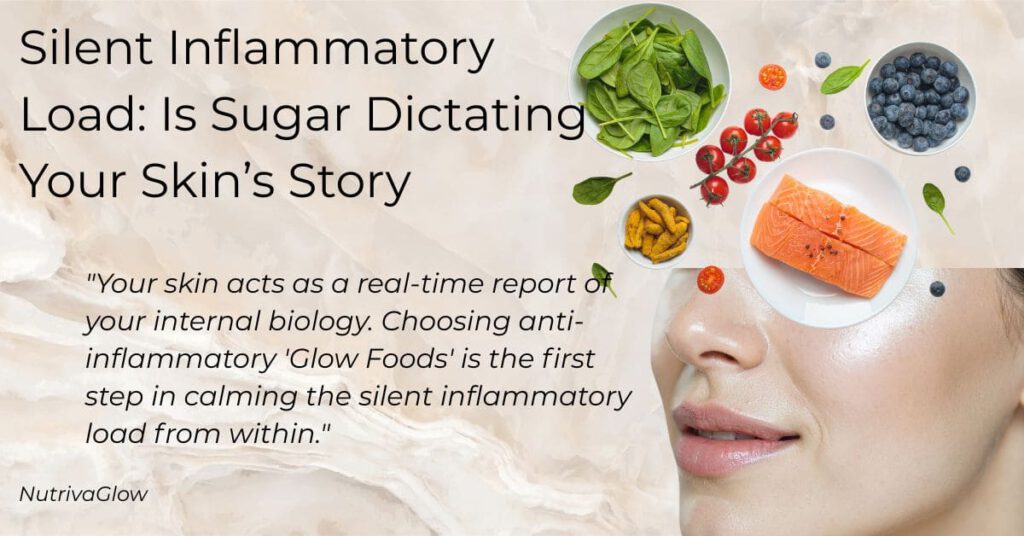
The Silent Inflammatory Load: Why Your Skin Reflects Your Internal Biology
By the NutrivaGlow Editorial Team · Reviewed by our Wellness Research Board · Updated April 2026 · 7 min read
We spent three weeks reading clinical trials so you wouldn’t have to.
Not blog posts about clinical trials. Not Instagram infographics that cite “studies show.” The actual papers — randomized controlled trials, longitudinal cohort studies, and systematic reviews published in peer-reviewed journals and indexed in PubMed.
What we found surprised us. The most persistent skin issues aren’t always about what you put on your face. They’re about a silent inflammatory load building deep in your biology—your gut, your immune system, and your hormones.
Here are the three pillars of the gut-skin connection where the science is strong enough that we feel confident sharing them — along with every source, so you can verify them yourself.
1-The Skin as a Reporting Organ
Dermatology used to treat most skin problems as local events: clogged pores, excess oil, or barrier damage on the surface. Today, a growing body of work on the gut–skin axis and brain–gut–skin axis reframes many inflammatory skin conditions—acne, eczema, psoriasis, rosacea—as systemic, not just superficial [1] [2] [3].
When your gut microbiome is imbalanced (dysbiosis) or your intestinal lining becomes more permeable than it should be (“leaky” in simple terms), immune messengers called cytokines can circulate at higher levels. These inflammatory signals prime your entire system. Researchers describe this as systemic priming. As a result, your skin is quicker to react to everyday triggers like stress, sugar spikes, or topical irritants [4] [5].
In practice, that means the face you see in the mirror is often a real-time summary of your internal biology. It shows how well your gut barrier is holding, how regulated your stress hormones are, and how heavy your silent inflammatory load has become.
The practical takeaway: Your skin is a reporting organ. It reflects the internal state of your gut barrier and immune system in real-time.
🌿 Go deeper: Our Morning Glow Checklist — a free downloadable PDF — includes a hydration tracker and a simple electrolyte recipe you can make at home. No purchase necessary.
2-The Glycemic Signal: When Sugar Talks to Your Skin
One of the fastest ways you “speak” to your skin is through your blood sugar. High-glycemic, refined carbohydrates—think sugary drinks, pastries, white breads, and pastas—create sharp glucose spikes. In response, your body releases more insulin and insulin-like growth factor-1 (IGF-1).
Research published in dermatology and nutrition journals shows that this glycemic signal matters for your complexion [9] [10] [11]:
- Elevated insulin and IGF-1 stimulate sebum (oil) production.
- They also influence how skin cells inside the pore mature and shed, a process called keratinization.
- Together, this environment favors clogged pores and inflamed lesions in acne-prone skin.
Clinical trials of low-glycemic diets have demonstrated reductions in IGF-1 levels and improvements in acne severity over time. This suggests that what you eat is not just “fuel”—it is hormonal information written into your skin [12].
The practical takeaway: Repeated sugar spikes are micro-bursts of endocrine and inflammatory stress that your skin has to absorb again and again.
3-Protect the Barrier While You Work From Within
Silent inflammation is not only an internal story. Reviews on skin microbiota and inflamm-aging emphasize that an over-stripped barrier is more vulnerable to oxidative stress and immune over-activation.
Support your barrier by:
- Choosing a gentle, low-fragrance cleanser and using it once or twice daily, not every hour.
- Simplifying your routine when your skin is reactive: use hydrating, non-comedogenic moisturizers. Be thoughtful with actives instead of layering everything at once.
- Treating sleep, stress management, and sun protection as part of your skincare, not separate from it.
Over time, this persistent inflammatory load can contribute to inflamm-aging—a slow acceleration of visible aging driven by cytokines and reactive oxygen species (ROS) that damage lipids, proteins, and DNA in skin cells [6] [7] [8].
The practical takeaway: Protective skincare habits give your skin a chance to express internal improvements rather than constantly being in repair mode.
Your 3-Step Glow Blueprint
- Step 1 — Feed the Microbiome: Aim to bias most of your meals toward whole, fiber-rich foods paired with quality protein and healthy fats.
- Step 2 — Tame the Glycemic Roller Coaster: Swap sweet breakfast cereals for oats with berries and nuts to stabilize your insulin response.
- Step 3 — Barrier Respect: Simplify your topical routine to hydrating, non-comedogenic moisturizers when your skin is reactive.
Why We Write This Way
At NutrivaGlow, we believe wellness content should meet two standards: it should be grounded in peer-reviewed research, and it should be honest about what the research does — and doesn’t — prove.
We don’t use phrases like “scientifically proven” because science doesn’t work that way. We say “research suggests” or “studies have found” because that’s more accurate. We cite our sources not to impress you, but so you can check our work.
This philosophy extends to everything we create — from our blog articles to our digital wellness tools to the supplements we carry. If we can’t substantiate a claim, we don’t make it.
That’s not a marketing strategy. It’s a standard.
Further Reading
Selected sources cited in this article, organized by topic:
Gut-Skin Axis & Microbiome: Thye et al. (2022), Biomedicines · Zhao et al. (2025), Int J Mol Med · Pachauri & Sharma (2025), Inflammopharmacology
Inflamm-aging & Oxidative Stress: Agrawal et al. (2023), Biology · Hussen & El-Sayed (2025), J Cosmet Dermatol · Li et al. (2023), Cell Mol Immunol
Glycemic Signal & IGF-1: Kim et al. (2017), Ann Dermatol · Okoro & Okoro (2023), Front Physiol · Vora et al. (2008), Brit J Dermatol · Wang et al. (2019), J Invest Dermatol
Medical Disclaimer
This article is published by NutrivaGlow, a brand of Digital Income Grow LLC, for educational and informational purposes only. It does not constitute medical advice, diagnosis, or treatment.
The information presented here is based on peer-reviewed research available at the time of publication. However, individual responses to lifestyle changes vary, and scientific understanding evolves.
Before making any changes to your health routine, diet, or supplement use, consult a qualified healthcare professional. This is especially important if you are pregnant, nursing, taking medication, or managing a medical condition.